
Search & AI / 15.08.2025 / 6 min
The Search Before the Search: How Intent Is Replacing Keywords.
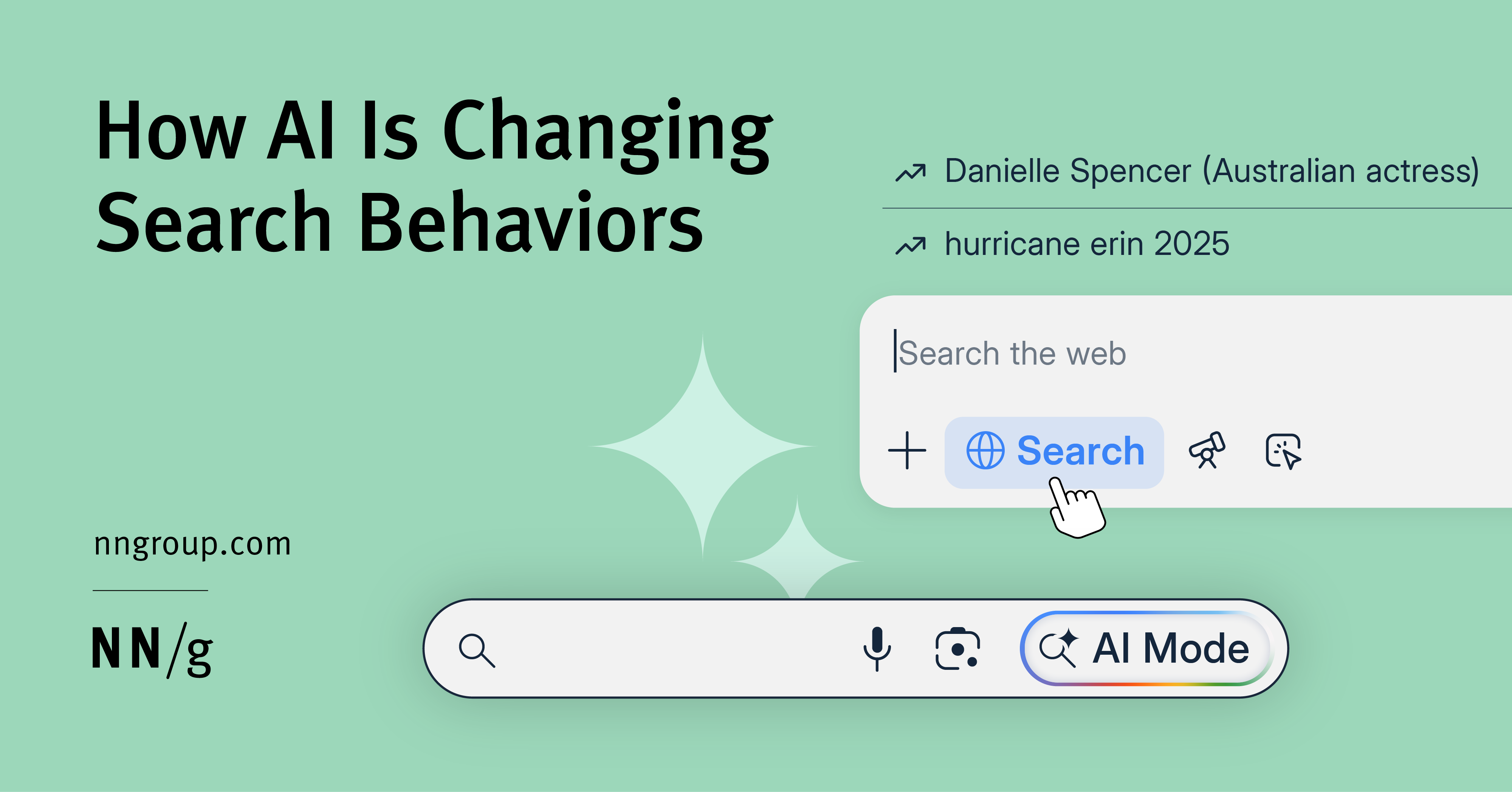
According to recent empirical research conducted by Nielsen Norman Group (NN/g), generative AI is creating a profound shift in user search habits. Traditionally, information-seeking began with 'keyword foraging'—a friction-heavy phase where users had to guess the exact terminology search engines required. AI interfaces have collapsed this barrier by allowing conversational, open-ended problem exploration.
However, NN/g’s findings highlight a critical nuance: long-standing user habits are notoriously sticky. Most people do not abandon Google; rather, they develop a hybrid workflow. They turn to conversational AI when problems are ambiguous or require synthesizing cross-disciplinary concepts, but instinctively return to traditional Google searches when financial, technical, or factual accuracy is non-negotiable.
“Users don’t stop searching—they split their journeys: open-ended synthesis in generative chat, and verified precision in Google.”
The most dramatic disruption occurs directly inside Google's search engine results page (SERP). Google’s AI Overviews claim the most prominent visual viewport, answering complex queries immediately and creating a surging wave of zero-click searches. For modern digital brands and agency partners, superficial SEO keyword tactics are obsolete. Sustainable visibility now demands deep technical architecture, rich semantic schema markup, and authoritative thought leadership that AI engines must cite as foundational sources.
KEY RESEARCH TAKEAWAYS
- 01. Ingrained habits keep Google at the center of critical discovery and validation.
- 02. AI Overviews dominate SERPs, turning content strategy from traffic volume to authoritative citation.
- 03. Web development must prioritize semantic structured data (Schema.org) and lightning-fast Core Web Vitals to stay visible to Google AI bots.
SOURCE & RESEARCH REFERENCE
Nielsen Norman Group — How AI Is Changing Search Behaviors ↗